Thursday, May 5, 2016

THE PIN STRIPE.


Here is a little story about how a functional feature became slowly a stylistic advantage: the pin stripe. 

This yellow stripe just under the MIZUNO Sky Road upper has had a function of either soften the foot bed for comfort or harden the footbed for enhanced performance or stability.


From the early 60's to the late 80's athletic shoes were fitted with different harness / materials in order to give the athlete the best of cushioning combination. 

Sometimes, due to technology choices the midsole separation was mandatory: Nike air wedge had to be surrounded by a PU foam. the Pegasus GX and the Windrunner are the reason why the midsoles are horizontally splitted.


Excepted few products made out of PU foam and mostly painted in order to avoid the yellowing effects (air Stab and heel part of the pegasus), The 90's offered pretty much plain white compressed molded EVA unpainted. 

One of the first disturbance arrived with the Nike air Talaria designed by Tinker Hatfield and team. This products offered a bunch of novelties in the footwear industry back to 1997. In this case we just have a look at the EVA sole. It shows two painted areas that link visually the upper to the midsole as if the products makes one discontinued graphic story. This is maybe the very first example of 2 distinctive colors set by painting over an EVA sole. 
We ended the first decade of 2000's with THE TREND. 

The New century questioned the white foams and the perceptible thickness, in a world looking for shoes visually closer to the ground while offering the same beneficial cushioning. 

2000's are also the year of the injected EVA Democracy. One foam, few drop-in techs and no external values. Thats maybe the reason of the creation of the HOLY painted pin stripe.


During my really small contribution to the Adidas Boost design exploration, I came up with this study. We realize the power of this TREND across all major actors of the field. 

We also guessed the end of the common EVA era and the beginning of the new foam tech Era started by nike and the Lunar foam.


Working for the Boost project, We questioned the reason the why we had to follow this path for the upcoming introduction. The first Boost generation did follow THE pin stripe TREND, the second generation of boost happily celebrated the return of the decomplexed full foam.

We are in 2016 now, New technologies are the reason to assume foam with plain color and verticality again because the benefice isn't visual-first anymore its all about EXPERIENCE.


2016 celebrate also the return of the color blocking or the color blocking that are more radical and graphic. The link isn't function driven first, it is almost fashion or industrial product oriented. I see this blocking alternative as a micro trend manifesto.
It looks like THE pin stripe TREND is slowly left for other manufacture solutions such as the algorythmic ornaments or the lazer engraved finished products turned into faded colors and degradés. In that case, we are at the beginning of a new trend that tends to Marry the function and the mathematic surfacing to new tech manufactures. 

I would really consider this direction as the next BIG thing in footwear. just look at the demand for Generative designers and engineers across the profession.


Wednesday, April 27, 2016

THE LIGHTWEIGHT BATTLE


The "Beautiful Game" feet endured a revolution back to the year 2002 and the introduction of the first NIKE mercurial Vapor at the world cup in Japan/Korea. the text above state the spirit of the actors in integrating the values of Michael Johnson golden shoe into football.

This shoe is a pure revolution since it integrates 10 major improvement in industrial footwear. Those values which have been a guidance for the next 15 years of lightweight boot design and engineering. what a Vision fitted in a minus 200 gr.


4 years later Puma launched the 165 gr shoe called PUMA V1 06 in the year of the world cup held in Germany. The Carbon fiber plate has been the first ever mass commercialized in football history.

Even if it comes third after a fila boot and the first generation of adidas F50, the v1 features the really first fine ripstop fabric as the main upper material.


The year 2008, adidas innovation team teased the rest of the company with an objective to answer the need of players to accelerate the game. 

Reacting after an advice given by Wolfgang Dremmler player scout at the Bayern Munich, AIT came up with this product called the ADIDAS DASSLER weighting 136 gr, performing the first ever triangular studs in history injected in polyamid and nano carbon fiber. 

All about speed, the shoe features the very first horizontal stripes, the future adizero branding principle.


The 2010 FIFA world cup held in South Africa celebrated the best scoring boot of the tournament. the shoe featured the silhouette, the branding, the derived stud shapes taken from its older sister the Dassler. 

This fantastic shoe demonstrate the strenght of a product designed with simplicity and guts that makes it a timeless piece of performance. 


The Nike mercurial vapor Initiative created a true revolution which wide spread accross all main actors of the field, with different constructions, stories and partnerships.


136 gr were apparently not enough, neither full opaque fabric. Adidas and Puma pushed the boundaries way further.

Adizero 99 gr  has been commercialized in a limited number starting by summer 2015, while Puma radicalized the finesse of the two matches only 120 gr EVOSPEED SL.

Are we now reaching the limits of such exercise?


Apparently not if we trust this image. The lightweight story maker has lost the battle in 2006 in favour of its competitor Puma and the V1 06. 

Nike featured heavier shoes since then. This swoosh-less prototype promises an approximate 80gr . I have no evidence of an intro date so far....

would somebody challenge the pinnacle of lighter boots?

Wednesday, October 7, 2015

ENDLESS CREATIVITY.....


It can be Fused, Waxed, Sintered, Z-Corped, Polyjeted, Glassed, Cemented or Resined. 3D printing represents for sure the next product frontier. 

Not alone, the principle is now in the hands of Generative designers or inverted engineers whose are blending together the mathematics, the architecture and the engineering processes into one object. 

Softwares are evolving to catch up with the technology. Autodesk and PTC to name a few. Well known traditional printer manufacturers are feeding the market with time challenging machines. 

Countless university programs are also creating their own systems. Not to mention the never ending growth of material variety, chemical formulas and soon Nano elements in duo or trio.....endless projection of endless creativity. Every industry class is concerned, lets have a look at the footwear now.

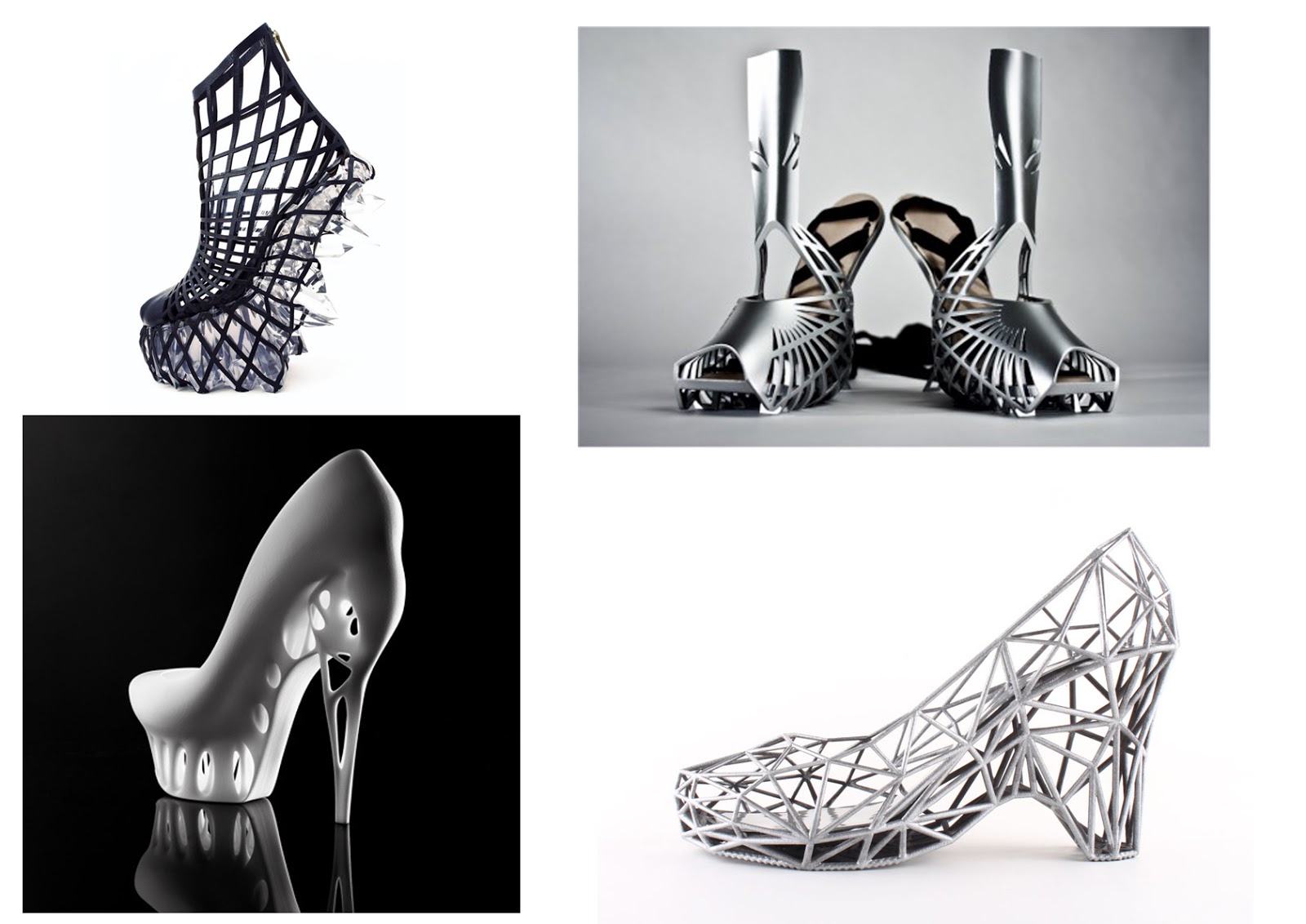
Lets split the visit in two distinctive chapters, one for Fashion and later below one dedicated to performance. What you see above is almost a literal use of the parametric for a piece of footwear, meshes or crossings are kind of expected in filling the shape of an high heel shoe.


Footwear /3D printed evolved dramatically this year 2015 by the industrialization of this process at UNITED NUDE a UK brand.  Not only Polymers but also metal parts are considered.

The 2015 Design week in Milano featured a joint venture in between United Nude and renown Designers in 3D promoted exhibition. The work done so far is wonderful. Again, creativity is endless as far as the products can be crafted without any dampening management. The challenge in Performance tools is way more demanding....


A bit of History: In Performance products, if I believe the retrieved patents, Nike has been the first to investigate in footwear 3D printing and generative design back somewhere in between 2005 and 2006. 3 top athletes been given a post sport fully 3D printed mule at the 2008 Olympics: Asafa Powell, Kobe Bryant and Liu Xiang. 

A careful look at the shoe show similar structures of the Beijing bird nest stadium. Nike never communicated this chapter and pictures are hard to find on internet as well.

I found another, this time, communicated By nike, development exposé of the air rejuven8 introduced in 2008. I also found the patent description with every detail (thanks to Google Patents). 


The process was so close to 3D printed fabrics (bag and dress) that came the hope to see the introduction in 2008 of a full printed upper or why not a full shoe made out of the principle.  


Sometimes hopes come too early my friend. the shoe turned out to be a regular post gridded Air Kukini TPU material with a removable sock like upper, everything bonded over a regular type of midsole. 

Patience..... nothing until 2012..... No commercialized footwear item with a 3D printed part, no performance product either given to any athlete until....


.....NEWBALANCE. 

In fact, NewBalance is the first manufacturer to endorse an athlete with a performing 3 D printed plate. NewBalance is also the first to showcase a potential midsole/foam fully printed (google source) with Partner EOS.


2013, Nike becomes the second manufacturer to endorse an athlete with a performing 3 D printed plate. and the first to make it available in a limited edition. 2014.....2015......nothing .......I can't believe in a try only. NB and NIKE have in public, recorded several job adds for generative designers. 


3D base material is cost and time expensive. I don't believe in a mass construction of items like the one above for tons of reason I do not have room enough to bore people off.


True story: People know how much I appreciated my managers at Adidas. But I felt a little alone in 2003 when I sketched those, having in mind the set of an unexpected internal footwear show based on technology called at that time Stereolithography. 

I planned to make and Polyjet print those hollowed midsole in order to show a potential future of the footwear industry.  But in 2003, People seemed to be everything but ready to waste their time on it. 


I did this in 2009, when finally the subject became a late company matter....those are just ideas, made in few hours, without any target price or consumer kind in mind no function either, trust me, there is here nothing realistic in this design iteration.

I am so eager to see what the sector will offer us in the future. There is no doubt, we are at the real beginning of an endless creativity.

Saturday, September 26, 2015

UNEXPECTED FALL 2004


Another true story, the one that happened to some of us, you know when there is an open window in your brain in what the future can be. This chapter states exactly this feeling I had back in 2001 when I started to project a vision of the performance footwear with a 5 years scope. 

I named it Unexpected fall 04 and sent it to my friends at Nike. Why Nike? Because this brand always been at the pinnacle of innovation in this field. Will follow 4 chapters, Running Lifestyle, Running Performance, Sports Wear and Training. 12 models.


Running Lifestyle: I always liked the Nike Catalogue page layouts and decided to communicate the content as if people in the company hold their probable future. Everything is invented, the products, the constructions, the arguments, the names etc.... same for the other following categories.


For the running iterations, One star is selected, a 360 degree air max called Max Opulence. Above the inspiration board


The product shows the blend of 3 distinctive "so called" technologies. A hollowed chassis in which 360 pods of air are inserted. The pods are the likes of the fall 04 introduced Nike free in a 360 manner as per the air max 2006.
First generation of Nike free launched in fall 2004
first air max 360 lauched in 2006


Running Performance catalogue page.


Running Performance: Already Tired of layers we were finding in shoe making at that time, I introduced the idea of thermo-forming upper, as if the shoe was tailored to your foot morphology. 


Impossible details of the star product. Few years later I realized how difficult this shoe is in term of construction. But I still believe today in thermo forming.


Sports Wear inspiration page.


Sports Wear catalogue page where you can see the association of full grain leather and translucency (see below). 3D crafted fabrics and embossed jacquards, are already considered in the vision. Molded EVA with integrated air max unit...or 3D heel EVA replacement of usual integrated plastic heel counter. Some of the options have been lately introduced in the market in summer 2015 like the latest KD8 Basketball shoe.
Speaking about transparency and full grain Leather combination,  I have been almost in synchrony with Designer A cooper who designed the shoe in 2001 and saw its introduction in 2003. He answered and designed a basketball icon, I suggested a sleep-on sportswear daily companion with a close to the foot full zoom air visibility.


NIKE KD 8   2015 and its heelcounter / midsole extended 


Training inspiration page.

Training catalogue page where you can see the association of thermo forming base upper over the air systems, the return of the air 180 expressed in a different way,  and a funky version of EVA midsole that reminds of a NikeFree individual pods. 


We are almost 15 years later, and I still believe this small exercise of projection was worth making it. The reality turned the product concepts way simpler than I thought, while I am still surprised to see similar solution hitting the market later on. 


The reason is simple, creative Ideas are hung over our heads. I just picked some of them.  


still today.........


Friday, September 25, 2015

ALL ABOUT STUDS (part 1)


This picture alone tells the story of one of the longest scientific opinion conflict when we speak about studded football shoes. Whats more efficient? Rounded stud or Bladed studs. This ever unresolved question rolled us for a long debate which, (can you believe?) lasted 50 years.


The first battle saw the victory of the Rounded studs Era. Here in picture, the last piece of art developed with an accurate eye of Adolf Dassler, the founder.


The second Battle defeated the Round studs and gave birth to the blade studs era from 1996 to 2010.

Some brands could not decide wether Round or Blades was the right answer. They implemented both of them in an hybrid functional manner: soft and firm ground. Lotto zhero gravity.

Ah The blades: if you are coming from another planet, and see Bladed shoes, you might imagine a sport where movements are generally made in a lateral motion, a bit like a Crossfit specialty on grass only......


But Football/Soccer is everything but only lateral motion. This is this functional context that Harald, Jürgen and I started to question in 2008.


Looking for a way to accelerate the game, I did a converged study in between soccer and track and field sprint discipline.


We looked at the stud placement in forefoot that compromise the two sports. from an exo-sourced document, some of you might recognize.


Once the position fixed, we declared the acceleration the cutting and the breaking zones. I analyzed the zones according to these two maps obtained from another exo-sourced document, in Google Patent, from the Mizuno stud study made available for all.


A new generation of stud is born, semi round at the top and triangular at the base for an increased 3 directional traxion pattern. 


In orange are the studs and shapes, fruits of our research, Adidas The Dassler Project,  the best ever recorded traxion at Adidas in history. 


In yellow is the modified pattern and shaped studs that characterize the new era of triangular studs at Adidas, the F50 limit launched in 2010.  no more Rounds, no more Blades.....but Deltas.


We kept our focus in improving the delta franchise with medical support in order to create in 2014, the Zonic system introduced the year of the world cup in Brazil and still implemented in 2015 in Messi's signature shoe and the late X Chaos line


I spotted different aficionados of the delta studs. I would love to hear or read what decided these 7 brands to opt for the deltas. Unfortunately the information is not public. But I can certify it, all of them came out after 2011.


Harald G, Harry K, Jürgen W, Stefan S, marco M, Dirk M, Helmut H, Bob K, Martin L, Jamal N Volker S, and few others became the devoted makers of the third generation of studs that are proven to reduce athletes injuries.

Sometimes, when I wonder why I am doing this job, this article looks like a good reminder.